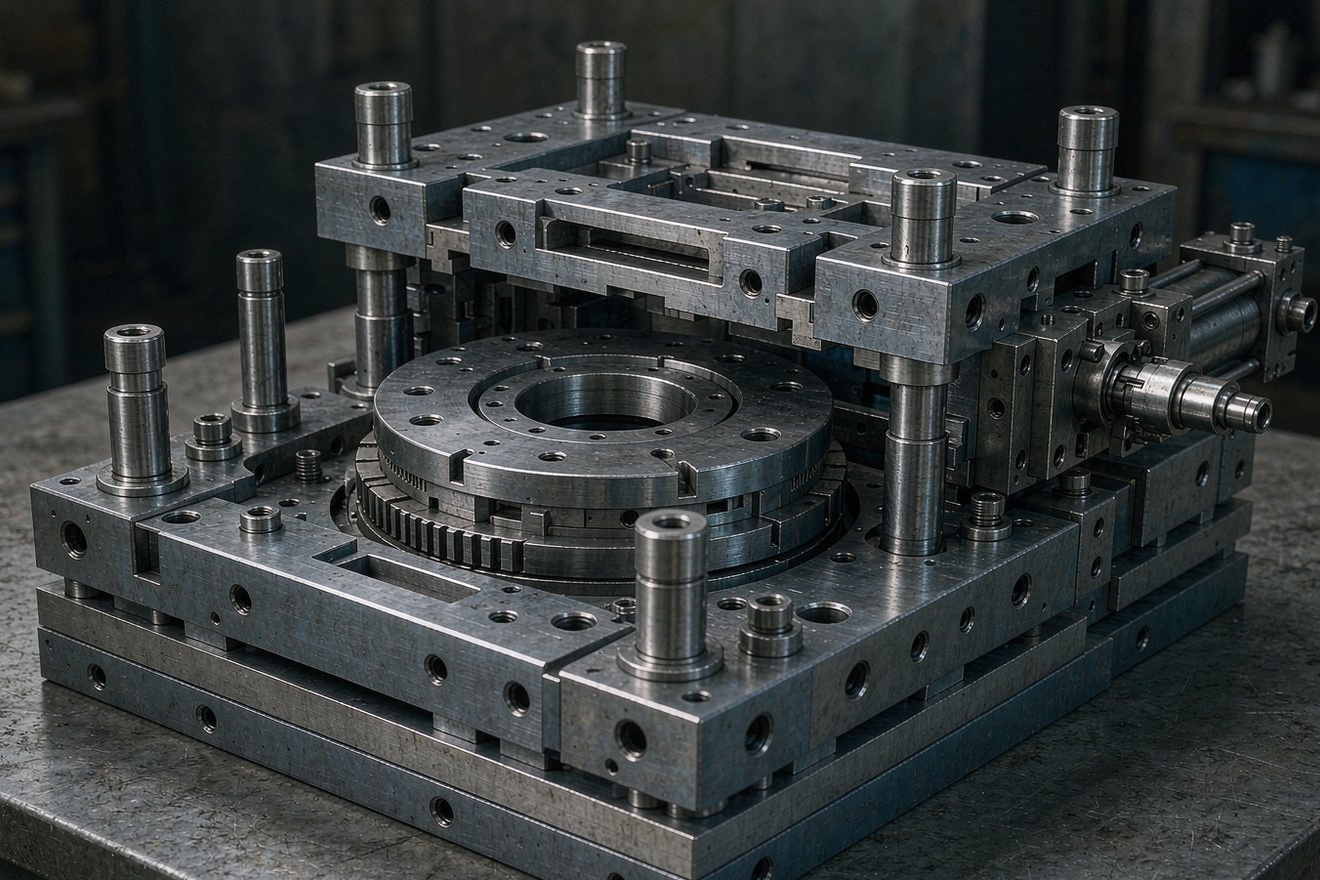
Why do die casting mold bases need thicker plates than injection moulds?
Because the cavity pressure and the thermal gradient are both higher, and the plate is hot through its thickness rather than at the surface. A plate sized for an injection mould will deflect under die casting pressure, which shows up as flash and short shots at the centre of the part. We add 15 % and increase support where the shot weight justifies it.
Which steel do you recommend for an aluminium die casting base?
H13 (1.2344) hardened to 44–48 HRC is the default for cavity and core plates; 1.2343 is worth the extra cost where thermal load is severe or the part has thin walls and long cores. Frame and support plates can be 45# or 40Cr — there is no benefit in paying for hot work steel where there is no heat.
Turntable or reverse-stack for a two-shot mould?
Turntable when the two materials differ a lot in temperature or need independent temperature control, and when the press has the platen space for the rotation. Reverse-stack when mould height is limited or the part is small and the cycle time matters. Send the press model and we will check the rotation envelope before quoting.
Can you machine a base for a mould that is already in production?
Yes. We work from the existing drawing or reverse-measure the plates, keeping the guide system and pocket datums identical so the new base is a drop-in replacement. For rebuilds we can re-machine pockets and replace pillars and bushes rather than scrap the frame.
What is the lead time for a die casting base with heat treatment?
Usually 18–25 days including heat treatment and finish machining, because the plate has to be roughed, treated and then finished — the sequence cannot be compressed without risking distortion. Standard and custom injection bases are 7–20 days.
Do you supply the stamping die sets as a complete assembly?
We machine the die set — bolster, punch holder, stripper and guide system — and can assemble with your inserts or supply the set as machined components for your own fitting. Ball-bearing guide pillars and bushes are available in MISUMI-equivalent sizes.